
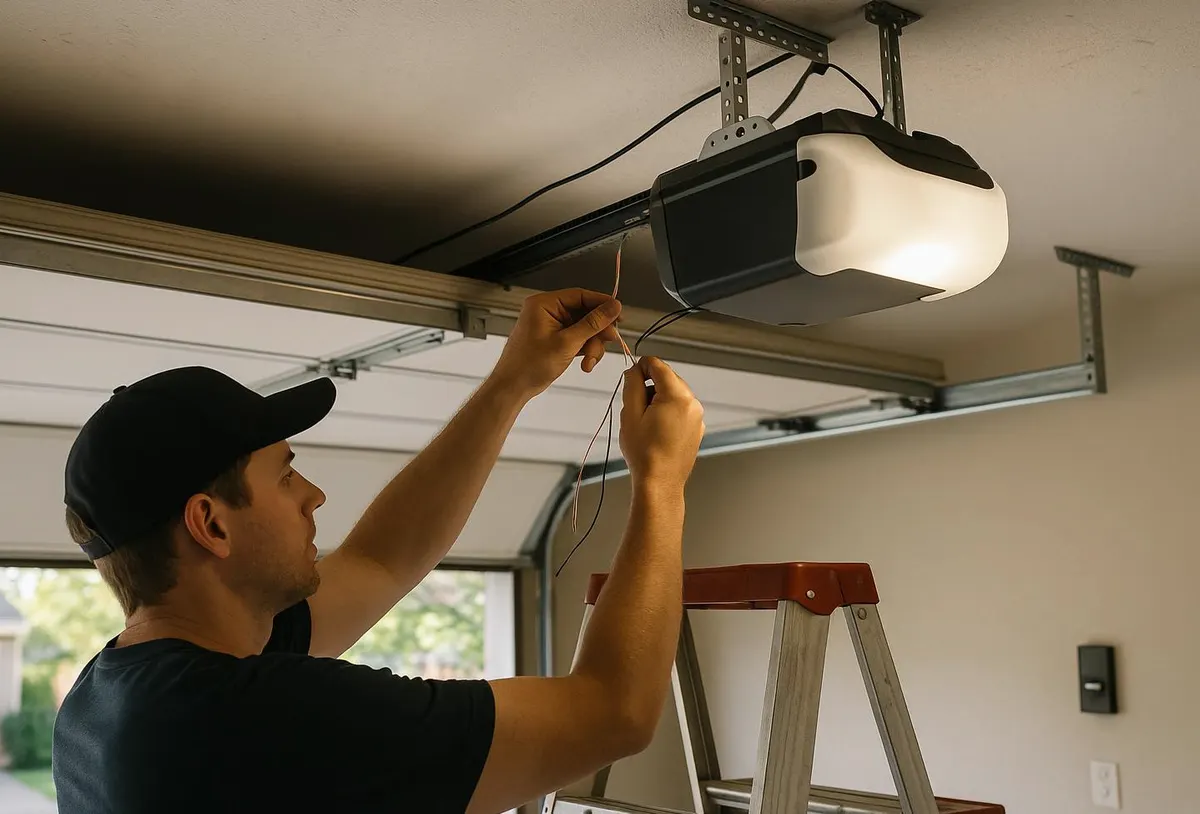
What a technician usually finds on these calls
The call almost always starts the same way: "The door reverses halfway down" or "it slams the last six inches and we're worried it's going to crack the panel." One spouse says it's the sensors. The other says it's just old and needs replacing. Nine times out of ten, it's neither — it's the force and travel limit settings on the opener, and they drifted out of adjustment months ago without anyone noticing.
This is common enough here that it's worth settling once and for all, because guessing wrong means either living with a door that beats itself up every day or calling for a repair that wasn't actually needed.
Travel limits: where the door is supposed to stop
Travel limits tell the opener exactly how far to run the door in each direction — how far down before it's "closed," how far up before it's "open." If the down-limit is set too short, the door stops a few inches above the floor and never seals, which lets in humidity, bugs, and wind-driven rain during afternoon downpours. If it's set too far, the opener keeps straining the door into the floor after it's already shut, stressing the bottom panel and the track.
Symptoms of bad travel limits:
- Door doesn't fully close, leaving a visible gap at the bottom
- Opener keeps running/grinding after the door looks closed
- Door reverses right before touching the floor, every single time
Force limits: how hard the opener is allowed to push
Force settings control how much resistance the opener will fight through before it decides something's wrong and reverses or stops. This exists as a safety feature — if a kid's bike or a pet is under the door, the opener should back off instead of crushing it.
The problem is that force gets set once, at installation, for a door and track in a certain condition. Humidity swells wood-composite panels and wood jambs, salt air stiffens hinges and rollers with light surface corrosion, and both add resistance the opener has to push through. If the force was set correctly a year or two ago, it may now be too low for the added friction — so the door reverses on perfectly normal attempts to close. The homeowner fix is usually to crank the force up. That's the move that causes real damage: an opener forcing its way through a stuck or dragging door puts the strain into the panels, the cables, and the spring system instead of fixing the actual drag.
Why this matters more in this climate
Afternoon storms and coastal humidity mean tracks and rollers don't stay in the same condition year-round the way they might in a drier climate. A door that ran smoothly in the dry season can develop drag by the time summer humidity and salt air have had a few months to work on the hardware. Bumping the force dial compensates for the symptom but not the cause, and over months that extra force fatigues cables and can bend panels, especially on wind-rated doors that are already heavier than standard ones.
How to actually test it (no guessing)
- Place a 2x4 flat on the ground where the door closes. Run the door down — it should reverse immediately on contact. If it keeps pushing, the force is too high.
- Watch where the door stops fully open and fully closed. It should seal at the bottom without gapping and without the opener continuing to run.
- If either test fails, the fix is adjusting the dials in small increments and retesting — not cranking one setting to compensate for a problem somewhere else in the system.
When to call Marco Island Garage Door Pro
If the door still won't close right after basic adjustments, or if it's reversing because it's actually dragging, off track, or fighting a worn cable, the force setting isn't the real problem — something mechanical is. That's when it's time for an inspection. We handle Garage Door Opener Installation with correctly calibrated force and travel from day one, and Garage Door Cable Repair for the cases where excess force has already started fraying or stretching cables.
If your opener is fighting your door every time it closes, call Marco Island Garage Door Pro for a same-day check in Marco Island, FL — we'll find the real cause before it becomes a bigger repair.